
 By Plumber in Auburn Hills, MI, plumbers on Pond Run in Auburn HillsPublished October 28, 2026Last updated October 28, 2026
Finding sewage backing up through a basement floor drain is alarming, and the first hour is about protecting yourself and stopping more from coming up, not about cleaning it. Keep people and pets away, stop running water anywhere in the house, and do not touch the standing water with bare hands, because a sewer backup carries bacteria that ordinary flood water does not.
Here is what to do in order, what to leave alone, and what the backup is usually telling you about the line.
Stop adding water to the system
A backup means waste cannot get out, so everything you send down a drain makes it worse. Stop using every fixture in the house at once: no flushing, no sinks, no laundry, no dishwasher, no showers. If an upstairs toilet was the last thing run, that water is part of what is now on the basement floor. Tell everyone in the house to hold off until the line is cleared. This single step does more in the first minutes than anything else, because it takes the pressure off a line that is already full and buys time to get help in.
Keep clear of the water and protect the area
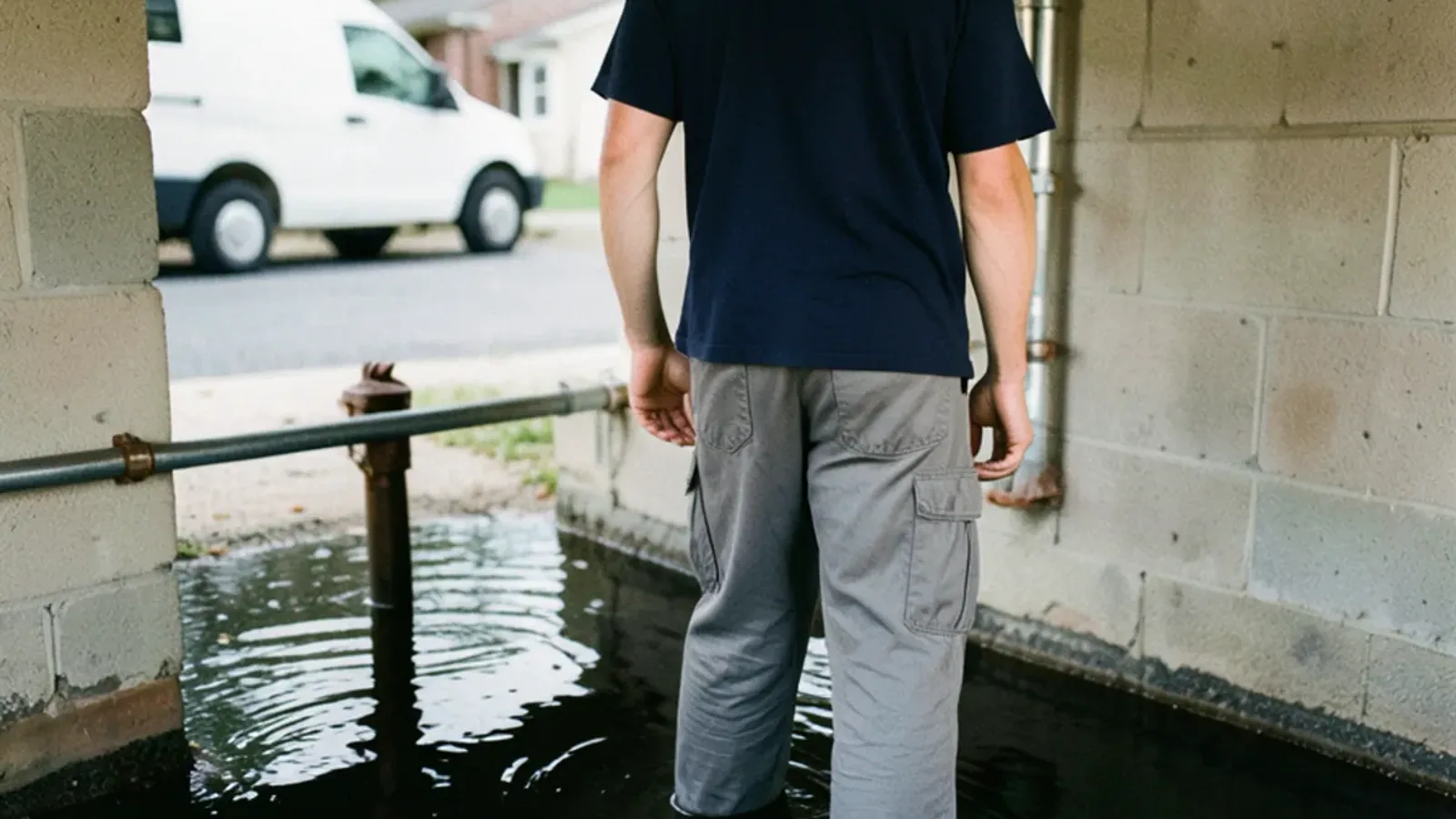
Sewer water is a biohazard, carrying bacteria and whatever the line contains, so treat it as one. Keep children and pets out of the basement, and do not wade in to start cleanup. If there is standing water near an outlet, a furnace or a water heater, do not reach in to unplug anything; shut the power to the basement at the breaker only if you can do it from a dry spot, and otherwise leave it. Open a window if the smell is heavy. The cleanup comes later, with the right gear; the first hour is about keeping people out of it.
What a basement backup is telling you
When sewage comes up at the lowest drain in the house, the blockage is usually downstream in the main line or the sewer lateral, not in the fixture above it. The lowest opening is simply where a full line overflows first. In older Oakland County homes the cause is often roots in a clay lateral or a collapse in an aging line; in newer homes it can be a grease or wipe clog in the main. Either way the fix is clearing and then inspecting the line, which is where a sewer camera shows what actually happened down there.
Keeping it from happening again
Once the line is clear, the question is whether it will back up again, and that depends on the cause. A one-time clog may not return; a rooted or broken lateral will, until it is repaired or replaced. A camera inspection of the line tells you which you are dealing with. For homes that back up repeatedly, or that sit low where the municipal sewer can surcharge in heavy rain, a backwater valve on the main can keep the city’s overflow from coming back up the house’s line. We lay out the options honestly once we can see the condition of the pipe. In older Oakland County neighborhoods a single backup is often the first sign that a clay lateral has been slowly rooting over for years, so even when clearing it solves the immediate mess, the camera is what tells you whether another one is weeks or seasons away, and that is worth knowing before the next heavy rain rather than after it.
Cleaning up safely after the line is open
Cleanup starts only after the flow is stopped and the line is flowing again, and it is not an ordinary mopping job. Sewage water carries bacteria, so anyone handling it needs gloves, boots and eye protection, and any porous material it soaked, carpet, cardboard, drywall it wicked up into, pad under flooring, should be discarded rather than dried and kept. Hard surfaces get washed, then disinfected, then dried out with fans and a dehumidifier so what is left behind does not turn into a mold problem weeks later. For a finished basement, or any backup that covered a real area, professional remediation is worth the cost because the health risk is in what you cannot see once the surface looks clean. Small, contained backups on a sealed concrete floor are the ones a homeowner can reasonably handle alone, and even then the protective gear is not optional.
Questions people ask about this
What should I do first when sewage backs up into the basement?
Stop running water everywhere in the house, since every drain you use adds to the backup. Keep people and pets away from the standing water, which is a biohazard, and do not start cleanup by hand. Then call for help and describe what you are seeing, because the blockage is usually downstream in the main line.
Why did it come up in the basement and not the bathroom I was using?
Because waste backs up at the lowest opening in the system first. When the main line or sewer lateral is blocked, the line fills and overflows through the lowest drain, which is almost always the basement floor drain, even though the water you ran came from a fixture upstairs.
Will a basement sewer backup happen again?
It can, depending on the cause. A one-off clog may not return, but roots in a clay lateral or a broken line will keep backing up until the pipe is repaired. A camera inspection shows the real condition, and for low homes a backwater valve can stop the municipal sewer from surcharging back into the house in heavy rain.
Want a plumber to look at your situation? We're on Pond Run in Auburn Hills.
(207) 419-2600